Custom brush seals and wool pile weatherstripping for sliding doors, windows, equipment and industrial gaps. Compare channel-insert, adhesive-backed and carrier-mounted options by pile height, base width and operating fit.
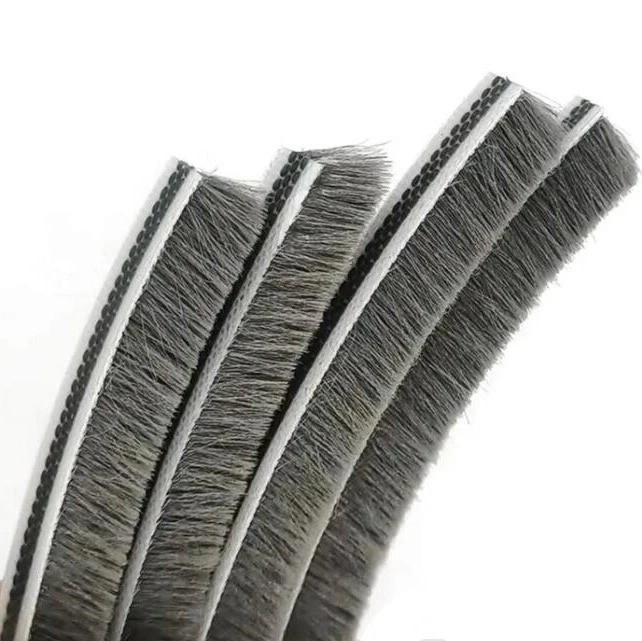
Choose pile height from the measured free gap and intended interference, then confirm base width and thickness against the mounting slot or adhesive footprint. Validate sliding force, filament recovery and wear in the real system. Use the pile-height guide to prepare minimum and maximum gap data before requesting a size review.
| Material | Polypropylene (PP) Pile + PP Base |
| Pile Height | 3–15 mm representative range; confirm available construction |
| Base Width | 4.8, 5.1, 6.9 and 11 mm examples; confirm slot or bonding fit |
| Color | Grey, Black, White, Brown or Custom |
| Adhesive | Standard / High-Bonding Adhesive Backing |
| Application | Sliding doors, windows, screen doors, wardrobes |
Start with the available mounting interface, then size the pile for the working gap. The mounting method determines retention, replacement access and the base dimensions required for a reliable fit.
| Brush seal type | Best suited to | Key dimensions to confirm |
|---|---|---|
| Channel-insert wool pile | Sliding windows, doors, screens and wardrobe tracks | Slot width, slot depth, pile height and interference |
| Self-adhesive brush weatherstrip | Retrofit sealing on clean, flat frames and equipment panels | Bonding footprint, substrate, pile height and installation temperature |
| Carrier-mounted industrial brush | Machinery gaps, guides, enclosures and dust-control interfaces | Carrier geometry, fixing method, trim length and operating direction |
For detailed pile-height calculations, use the brush seal pile-height guide. For production capability and custom tooling, see our brush seal manufacturer page.
The tallest or densest pile is not automatically the best seal. Excess interference can increase operating force and wear.
| Check | What to provide | What to validate |
|---|---|---|
| Gap and contact | Minimum/maximum gap, pile free height and intended interference | Continuous contact without excessive drag |
| Mounting base | Slot width/depth or bonding substrate and available footprint | Insertion, retention or adhesive bond |
| Motion | Travel direction, speed, cycles and allowable operating force | Friction, noise, filament recovery and wear |
| Exposure | Indoor/outdoor use, water, UV, temperature, dust and cleaners | Filament, base and adhesive suitability |
| Supply format | Roll/cut length, jointing, color, quantity, label and carton | Installation handling and commercial feasibility |
Approve samples in the real channel or on the real substrate. Record gap, interference, operating force and inspection criteria before production release.
Filament contact and interference should be balanced against the allowable operating force.
Confirm the filament, backing and adhesive against moisture, UV, temperature and cleaning exposure.
A selected pile may help limit dust, light or airflow; project-specific performance requires testing.
Pile height, base width, backing and packaging can be reviewed against the application and supply requirements.
In door and window sourcing, wool pile weatherstrip, pile seal and brush seal are often used for closely related flexible-fiber seals. Wool pile usually describes the dense PP yarn strip installed in sliding tracks, while brush seal can also refer to taller or heavier brush profiles used for wider industrial gaps.
A PP brush seal uses polypropylene yarn fixed into a narrow backing. PP offers low friction, moisture resistance and consistent pile recovery for sliding doors, windows, wardrobes and screen systems. Specify pile height, base width, density, fin treatment and adhesive or non-adhesive backing when requesting a quotation.
The detailed RFQ lets you specify pile height, base width, adhesive, color, roll length, quantity and attach a drawing or photo.
Review pile height, density, base width, backing and packaging options for OEM brush weatherstrips.
Select the mounting method first, then confirm pile height and contact pressure against the operating gap.
| Selection point | Grey wool pile brush seal | Self-adhesive brush seal roll |
|---|---|---|
| Mounting | Slides into a compatible narrow groove or channel | Bonds to a clean, flat mounting surface |
| Typical use | Sliding windows, doors, screens and wardrobe tracks | Retrofit frames, cabinets, equipment panels and wider accessible surfaces |
| Key dimension | Backing width and groove fit | Adhesive footprint and available bonding width |
| Installation check | Insertion, retention and replacement access | Surface preparation, pressure and adhesive cure conditions |
| Common risk | Loose base or excessive pile interference | Weak bond on dusty, oily, textured or incompatible surfaces |
Choose groove-in wool pile when the frame has a compatible receiving slot and repeatable retention is required. Choose an adhesive-backed brush when the mounting surface is flat, clean and has no suitable groove.
Measure the minimum and maximum operating gap, then select a pile height that maintains light contact without excessive sliding resistance. Confirm the result with a sample in the real assembly.
Provide the gap range, pile height, base width, mounting method, application environment, roll or cut length, color and order quantity.
Dedicated product pages with application guidance, specification references and project-specific OEM/ODM review.