Browse EPDM automotive weatherstrip profiles for vehicle doors, trunks, hoods, glass runs and body flanges, then choose the correct application, product detail or custom development route.
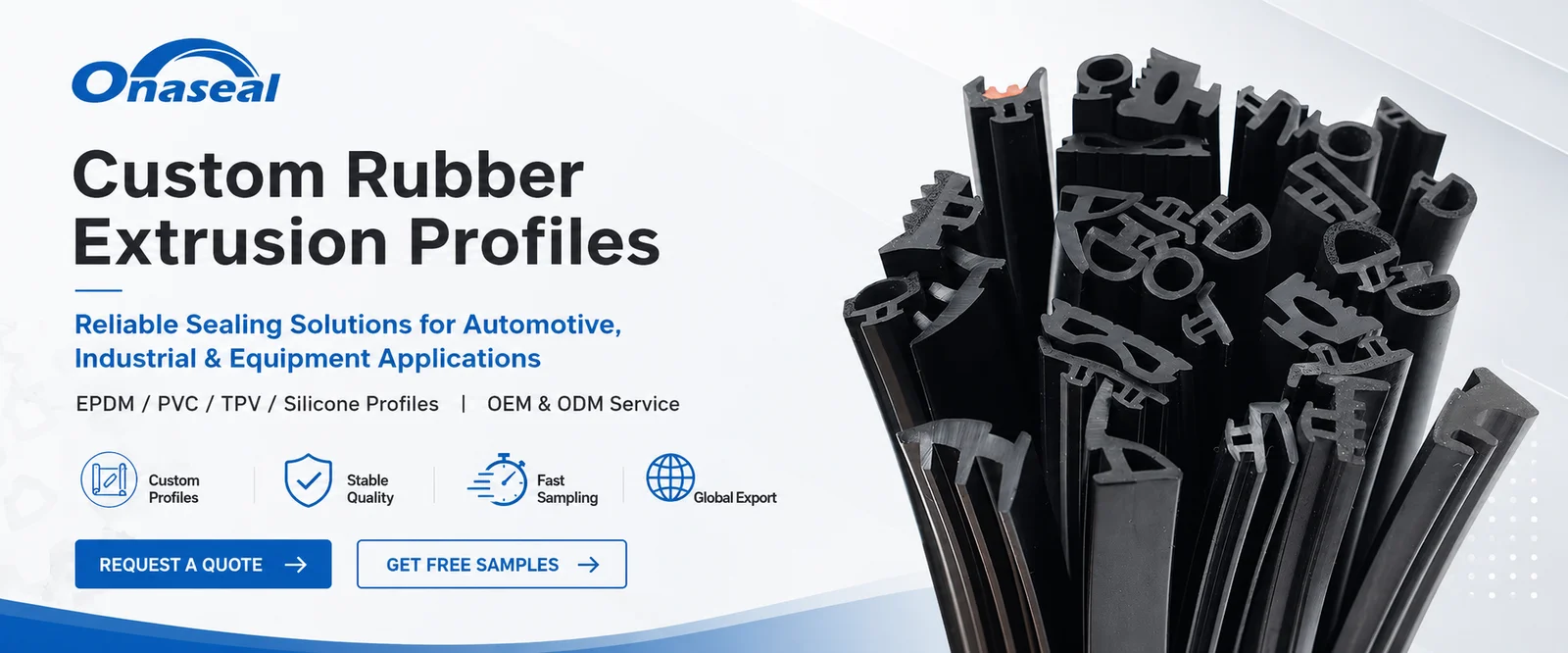
Start with a product or profile reference, then compare its section and mounting method with your vehicle opening. For a step-by-step review of mounting, gap, compression and exposure, use the car door weatherstrip selection guide.
Review the door-seal profile and application information before requesting a fit assessment.
Compare door and trunk sealing references with the installation interface and working gap.
Review OEM development inputs, sample evaluation and manufacturing requirements.
Compare door, window, trunk, hood and body-opening sealing inputs before selecting a profile.
These references do not guarantee fit for a particular vehicle. Confirm the cross-section, mounting interface and required length before ordering; sample availability and supply terms require review.
Automotive weatherstrip demand includes vehicle-specific replacement seals, aftermarket profiles and drawing-based OEM components. Buyers should separate universal profiles from application-specific parts and confirm flange geometry, working gap, compression, joining, coating or flocking, annual volume and validation requirements. Use the automotive sealing application guide to organize requirements by vehicle location.
Use an existing profile only after checking the cross-section and mating geometry. For a vehicle-specific part, send the installation position, end-view dimensions, physical sample or drawing, target quantity and required validation method.
A profile that fits one body opening should not be assumed to fit another. Select the development route from the installation interface and required function.
| Application | Key interface inputs | Common validation focus |
|---|---|---|
| Door opening seal | Body flange, working gap, compression, corner route, clips or retainers | Closing effort, water path, wind noise, retention and corner fit |
| Trunk / luggage seal | Flange geometry, deck-lid gap, water channel and joint location | Water management, compression continuity and splice position |
| Hood seal | Mounting interface, heat exposure, airflow path and under-hood fluids | Retention, temperature exposure and interference |
| Glass run channel | Glass thickness, channel geometry, travel path, flocking/coating and corner design | Glass movement, noise, insertion force and surface wear |
| Clip-on edge trim seal | Flange thickness, grip range, bulb position, bend radius and carrier | Pull-off, corner retention, compression and surface marking |
Vehicle/platform, installation position, drawing revision, section and overall routed length.
Solid/sponge zones, hardness, carrier, flocking, coating, adhesive, clips and joined ends.
Datums, dimensions, tolerance classes, compression targets, splice and corner acceptance.
Prototype and annual volume, validation plan, documentation, packaging and destination.
Catalog photographs show profile families, not guaranteed vehicle compatibility. Confirm fit using the actual body interface, approved drawing or authorized reference sample.
Universal profiles may be suitable for repair or general aftermarket use after fit testing.
Vehicle-specific profiles require matching geometry, routed length, corners, joints, retainers and validation criteria. A similar cross-section alone does not establish interchangeability.
The same bulb shape can behave differently when mounted on a flange, in a channel, with clips or by adhesive. Confirm retention before comparing outer geometry.
| Retention method | Key information | Typical risks to validate |
|---|---|---|
| Metal-carrier clip-on | Flange thickness, edge radius, grip range, bulb orientation and bend radius | Pull-off, corner lift, surface marking and carrier deformation |
| Push-in foot or arrowhead | Slot width, slot depth, insertion direction and substrate stiffness | Insertion force, pull-out, twisting and dimensional variation |
| Channel or glass run | Channel geometry, glass thickness, travel path and flocking or coating | Sliding force, noise, wear and corner fit |
| Clip or pin retained | Hole spacing, clip type, datum positions and routed length | Hole alignment, local stress and retention through bends |
| Adhesive-backed auxiliary seal | Substrate, footprint, surface preparation and service temperature | Bond loss, shrinkage, edge lift and installation consistency |
No. A photo can help identify the profile family, but fit requires the cross-section, mounting interface, working gap, routed length, corners, joints and retention details.
A universal profile may suit repair or general aftermarket use after fit testing. A vehicle-specific weatherstrip must match the exact body interface, routed length, corners, joints and validation requirements.
Send the vehicle or platform, installation position, dimensioned cross-section or physical sample, mounting method, routed length, material construction, quantity and required validation documents.
Review materials, profile development, joined-frame options and RFQ requirements for custom vehicle sealing programs.