
Custom EPDM Rubber Extrusion Manufacturer
Work with an EPDM rubber extrusion manufacturer to develop custom solid, sponge or dual-durometer sealing profiles from CAD drawings, dimensioned sketches or physical samples.
Send a drawing, sample photo, dimensions and estimated quantity for review. Sample availability, tooling, any charges and delivery terms are confirmed after the project requirements are reviewed.
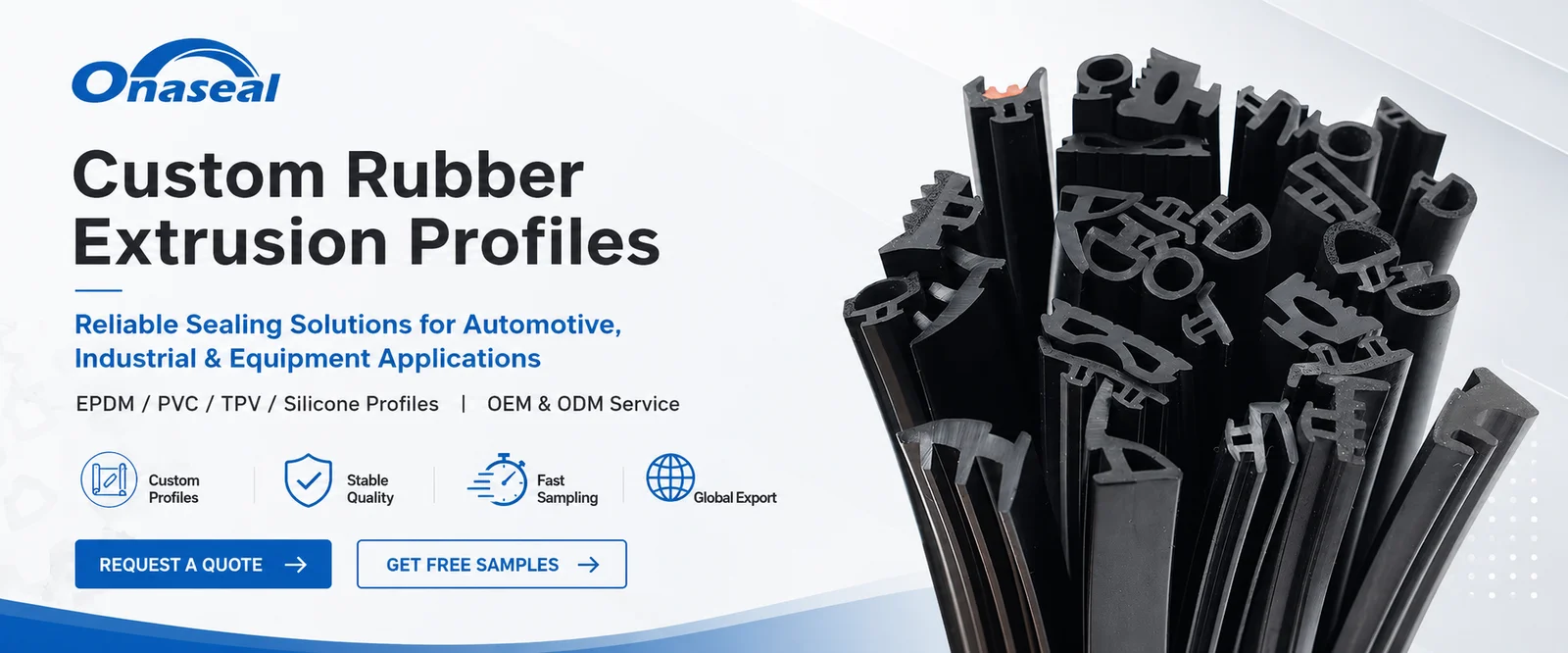
OEM Sealing Profiles Built Around Your Application
Onaseal supports B2B buyers, distributors and equipment manufacturers with drawing-based or sample-based profile development. The correct solution is selected from the mating geometry, operating gap, installation method, material exposure and order requirements—not from appearance alone.
For a dependable quotation, provide the cross-section, critical dimensions, material preference, color, required length, annual quantity and application photos. Trial samples should be fitted to the real assembly before mass production.
Read the related technical selection guide →| Materials | EPDM sponge, dense EPDM, silicone, PVC, TPE/TPV |
|---|---|
| Development input | 2D/3D drawing, clean cross-section sample or mating-part dimensions |
| Customization | Section, hardness, density, color, surface, cut length and packaging |
| Supply formats | Coils, reels, straight cut lengths, joined frames or application sets |
When Is EPDM a Suitable Extrusion Material?
| Service condition | EPDM selection guidance | Buyer must confirm |
|---|---|---|
| Outdoor weather, ozone and water exposure | EPDM is commonly selected for weatherseals and outdoor profiles | Exposure duration, compression, movement and required life |
| Hot-water or steam-related service | A suitable EPDM compound may be considered after temperature and media review | Continuous/peak temperature, pressure and chemical additives |
| Petroleum oils, fuels or hydrocarbon solvents | EPDM is generally not the default choice; another elastomer may be required | Exact fluid, concentration, temperature and contact duration |
| Very high or very low temperature | Do not select from material name alone; compound limits vary | Continuous and peak temperatures plus test or compliance needs |
| Food, medical or regulated application | Generic EPDM does not establish regulatory compliance | Required regulation, declaration, test method and approved compound |
Technical reference: Trelleborg's Material Selection Guide compares EPDM with other elastomers for weather, water, steam, oils and temperature exposure. Its published values are typical guidance, not a guarantee for every EPDM compound or finished profile.
What Onaseal Can Customize
Cross-Section Development
Review from CAD drawings, dimensions, samples and mating-part geometry.
Material & Compound
Material selection based on compression, weather, abrasion and service environment.
Secondary Processing
Adhesive, coating, flocking, cutting, joining and application-specific finishing.
OEM Packaging
Coils, reels, cut lengths, sets, labels and export packaging for B2B supply.
Compare Relevant Sealing Solutions
Automotive EPDM Weatherstrip
View specifications, applications and sample information.
V-Shape Foam Insulation Strip
View specifications, applications and sample information.
Custom Silicone Profiles
View specifications, applications and sample information.
Compare solid, sponge and edge-grip EPDM sealing strip types, or browse all rubber extrusion profiles.
What Determines a Custom EPDM Extrusion Quote?
| Input | Minimum information | Why it affects the quote |
|---|---|---|
| Cross-section | Controlled 2D drawing or uncompressed sample with dimensions | Determines manufacturability and tooling scope |
| Compound | Service environment, hardness/density and documentation needs | Defines material and validation requirements |
| Tolerances | Function-critical dimensions and measurement condition | Affects tooling adjustment and inspection planning |
| Secondary work | Adhesive, flocking, carrier, cutting, joining or holes | Adds processes, materials and acceptance points |
| Order scope | Sample quantity, first order, annual demand and destination | Supports production and packing calculation |
For solid rubber extrusions, ISO 3302-1:2014 can be referenced when agreeing dimensional-tolerance classes. The applicable class and critical dimensions must be specified for the actual project.
Four-Step OEM Cooperation
- Send a drawing, sample, photos and application requirements.
- Confirm section, material, dimensions, tolerances and commercial quantity.
- Confirm the tooling plan, produce a trial sample where needed, then approve its fit and agreed performance checks before batch release.
- Proceed with batch production, inspection, packaging and export delivery.
Get an Engineering Review
Include these details for a useful quotation:
- Cross-section drawing or clear end-view photo
- Critical dimensions and mating gap
- Material, color and installation method
- Length, quantity and packaging request
Buyer Questions
An existing profile can be reviewed as a reference. Send a clean uncompressed sample, cross-section dimensions and application photos; feasibility, tooling and final production dimensions are confirmed separately.
New cross-sections normally require extrusion tooling. Tooling scope is confirmed after the drawing and tolerances are reviewed.
Send a dimensioned cross-section in PDF, DWG or DXF when available. Mark overall width and height, wall thickness, channel or bulb dimensions, tolerances and the intended mating gap.
A clear end-view sketch or an uncompressed physical sample can be used for initial feasibility review. Final production dimensions and tolerances must be confirmed before tooling.
Yes. Sample approval is an important step before stable batch production.