
Updated: September 3, 2026 · Topic: D P E I foam seal profile comparison
Quick Answer
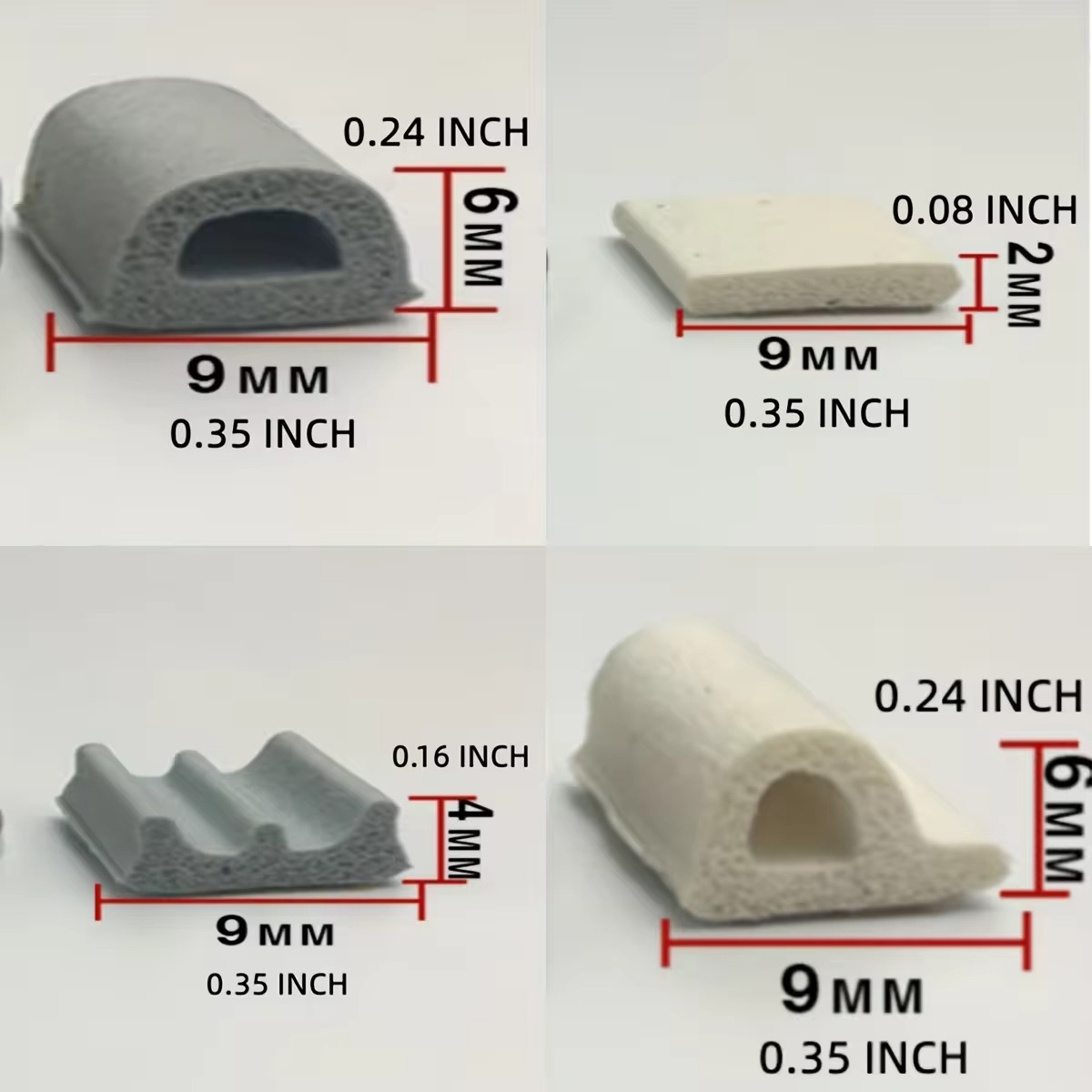
D and P profiles use a hollow bulb to seal medium or variable gaps with resilient compression. The pictured E profile has multiple raised ribs along an open, grooved section; it should not be described as a multi-chamber hollow bulb. I profiles are flat foam tapes used for shallow, even gaps, cushioning or insulation. Final selection must be based on the measured gap, available bonding width and acceptable closing force.
Key Selection Factors
| Factor | What to check | Why it matters |
|---|---|---|
| D profile | Doors, windows and enclosures | Rounded hollow bulb for resilient compression |
| P profile | Frame edges and offset contact surfaces | Bulb with a flat adhesive leg |
| E profile | Narrow frames; check available bonding width and compression | Multiple raised ribs and open grooves |
| I profile | Flat joints, cushioning and shallow gaps | Simple solid or sponge tape section |
Confirmed D, P, E and I Profile Sizes
Dimensions below are width across the adhesive mounting face × uncompressed thickness, in millimetres, for one individual strip. They are not the total width of a joined pair or a guaranteed installation gap.
| Profile | Available sizes (mm) | Product details |
|---|---|---|
| D | 9 × 6; 9 × 7.5 | D-profile dimensions and sample requirements |
| P | 9 × 5; 9 × 5.5; 9 × 6 | Compare P-profile options |
| E | 9 × 4 | E-profile selection details |
| I | 9 × 2 | I-profile selection details |
P-profile thicknesses of 5, 5.5 and 6 mm are separate variants, not a tolerance range. Larger D profiles require a confirmed cross-section drawing. Confirm fit, closing force and adhesive suitability on the actual assembly before ordering.
Recommended Buying Process
- Measure the application at several points and record minimum and maximum values.
- Share a section drawing, clear photos and details of the mating surface.
- Confirm material, color, mounting method, operating environment and order quantity.
- Test a sample on the real assembly before approving mass production.
After Choosing the Profile
Follow the sealing strip installation guide to prepare the bonding surface, avoid stretching the foam, handle corners and verify adhesion after fitting.
Common Specification Mistakes
- Selecting a profile letter without checking actual dimensions
- Stretching foam tape during installation
- Bonding to dusty, oily or wet surfaces
- Using too much compression and causing closure problems
What to Include in Your RFQ
Send the application, cross-section dimensions, mating-part dimensions, preferred material, color, length, quantity and packaging request. If the profile replaces an existing part, include an uncompressed sample and photos showing where it is installed. Onaseal can review drawings or samples for OEM/ODM production.
Related Onaseal Solution
See Multi-Profile Self-Adhesive Foam Weatherstrip, or send your drawing and target quantity for sample-availability and technical review.
Frequently Asked Questions
Can I choose a foam profile from gap size alone?
No. Use the measured minimum and maximum closed gap together with bonding width, contact geometry and allowable closing force. Then confirm compression and adhesive suitability on the actual assembly.
Can profiles be custom sized?
Yes. Width, height, density, color and adhesive can often be customized subject to tooling and order requirements.
How do I measure the gap?
Measure the closed gap at multiple points without deforming the frame. Record both the minimum and maximum.